
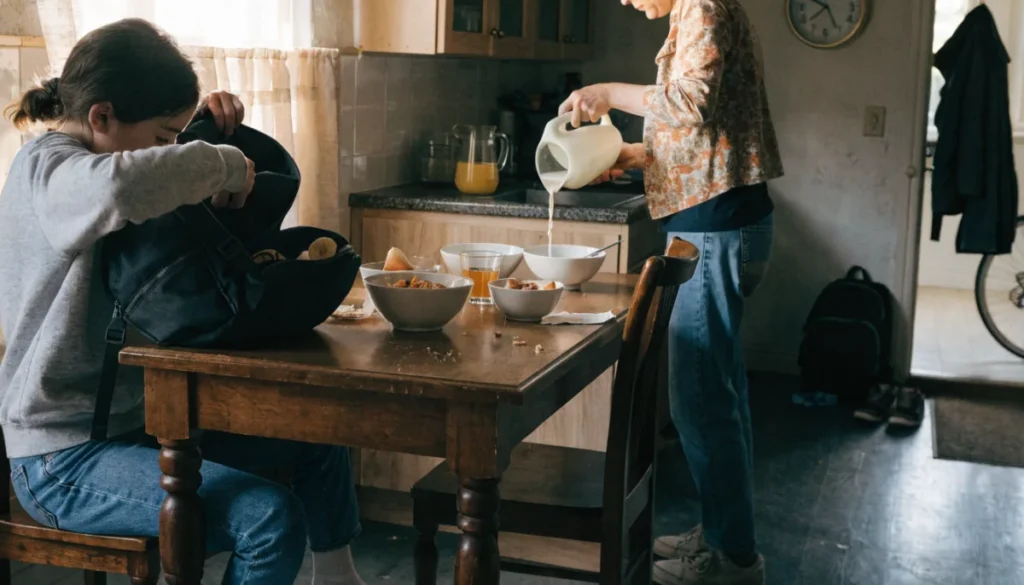
Nothing on this list is surprising. That is rather the point — children’s health is not decided by a discovery, it is decided by a handful of ordinary things repeated for years. The difficulty is never knowing what to do. It is starting without trying to start all of it at once.
1. Sleep, protected like an appointment
Canada’s 24-Hour Movement Guidelines ask for 9 to 11 hours a night for children aged 5 to 13, and 8 to 10 for teenagers. Sleep affects mood, concentration, appetite regulation and immunity — which means it quietly determines how every other habit on this list goes.
Start here: pick a bedtime and hold it on school nights, including Sunday. Consistency matters more than the exact hour.
2. Sixty minutes of moving
Walking to school counts. The playground counts. Fifteen structured minutes at home counts. It does not need to be a sport, and it does not need to happen in one block.
Start here: add one deliberate thing to the week — a Saturday walk, a fifteen-minute session, a scooter to school on Tuesdays. One, not five.
3. Breakfast that is not a dessert
Children who eat a reasonable breakfast concentrate better through the morning. Most cereals marketed to children are closer to a pudding.
Start here: swap one breakfast a week to eggs, oats, or plain yogurt with fruit. Keep it boring and repeatable.
4. Water as the default drink
Not a rule — a default. Water on the table, juice as something that occasionally happens.
Start here: put a jug on the table at dinner. Say nothing else about it.
5. Screens with edges
The useful question is not how many hours, it is when. Screens during meals and in the hour before bed do the most damage — the first replaces conversation, the second replaces sleep.
Start here: one screen-free zone (the table) and one screen-free hour (before bed). Adults included; children notice the exemption.
6. Meals eaten together
Regular family meals are associated with better eating, better vocabulary and better mental health in children — and the effect holds even when the meal is unremarkable. It is the sitting down that matters, not the menu.
Start here: three meals a week where everyone is at the table with no screens. Breakfast counts.
7. Cooking together
A child who helped make dinner is far more likely to eat it. They also learn, slowly and without being taught, that food comes from ingredients rather than packets — which is the habit that outlasts your influence.
Start here: one job, once a week. Tearing lettuce, stirring, pressing the blender button.
How to actually begin
Choose one. Run it for two weeks until it stops feeling like a project. Then choose the next. Families who try all seven in January have usually abandoned all seven by February; families who change one thing a month have changed seven things in a year and barely noticed.
If you want the practical layer, our recipes and workouts are free and built for exactly this — short, repeatable, and designed to fit the week you already have.