
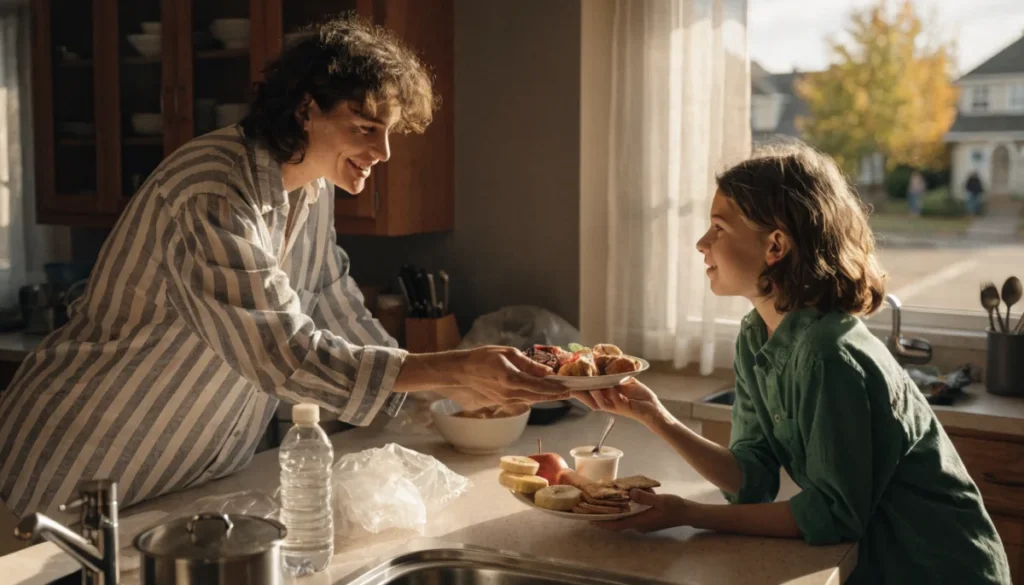
If you have ever watched a child eat one biscuit and immediately ask for another, you already understand the mechanism. It is not weak character, and it is not your parenting. Sweet, soft, quick-to-eat food is designed to be easy to keep eating — and a seven-year-old is not going to out-argue a product development team.
What makes a treat hard to stop
Three things, mostly. It is sweet, which we are all wired to like. It requires almost no chewing, so the body’s fullness signals arrive late. And it is usually within reach, in a cupboard, in a bag, at the checkout at eye level.
Change any of those three and the pull weakens considerably. Notice that none of them is “tell the child to stop”.
The Ottawa version of the problem
Between hockey practice, after-school programmes and a winter where nobody wants to cook, the snack drawer does a lot of work in this city. The rink canteen is not going anywhere. Neither is the vending machine at the pool, or the birthday-party loot bag.
That is fine. The aim is not to remove treats from an Ottawa childhood — it is to stop them being the default answer to hunger between 3pm and dinner.
What works instead
Make the good option the fast one. A child chooses what is easiest at the moment they are hungry. Sliced fruit in a container at the front of the fridge beats a whole apple at the back, every time.
Put out the vegetables before dinner. The hungriest moment of a child’s day is late afternoon. A plate of cucumber and hummus at 4pm gets eaten; the same plate at 6pm gets argued about.
Give the snack a place and a time. Grazing from 3pm to 6pm ruins appetite and keeps the palate primed for sweetness. One snack, at the table, then water until dinner.
Pair sweet with something slower. Apple with nut or seed butter. Yogurt with berries. Dates with cheese. The fat and protein slow everything down and the snack ends naturally.
Do not bring it into the house in bulk. This is the one that does the most and takes the least willpower, because the decision is made once, at the shop, by an adult.
Keep the real treats real. The rink canteen after a game, the birthday cake, the doughnut on a Saturday. Those are occasions, and children who have occasions are much less interested in the cupboard on a Tuesday.
Five swaps that hold up
- Apple slices with peanut or seed butter, instead of a granola bar
- Plain yogurt with berries and a drizzle of honey, instead of a flavoured pot
- Popcorn, instead of crisps
- Frozen banana rounds dipped in cocoa, instead of ice cream
- Cheese and whole-grain crackers, instead of a sweet biscuit
Where to start tonight
Pick one: put a container of cut fruit at the front of the fridge, or put a vegetable plate out at 4pm tomorrow. Do that for a week before changing anything else. Households that overhaul the whole cupboard on a Sunday are usually back to normal by Friday.
We keep a free library of snacks and fun treats built for this — five minutes, ordinary ingredients, and genuinely nice rather than a worthy substitute.