
A lot of advice about feeding children quietly assumes a particular kind of kitchen. Follow it literally and you end up cooking two dinners: the family’s food, and a beige plate for the child. It is exhausting, expensive, and it teaches the wrong lesson.
The assumption worth throwing out
Children are not born preferring plain food. They prefer familiar food. A child raised on berbere, garam masala, adobo or harissa finds those flavours normal, because normal is whatever appears regularly. The narrowing happens when a family starts making exceptions.
Your food traditions are not the obstacle. They are the most powerful tool you have, because they come with repetition, with family, and with meaning — three things no recipe can add.
Six ways to make familiar food appealing
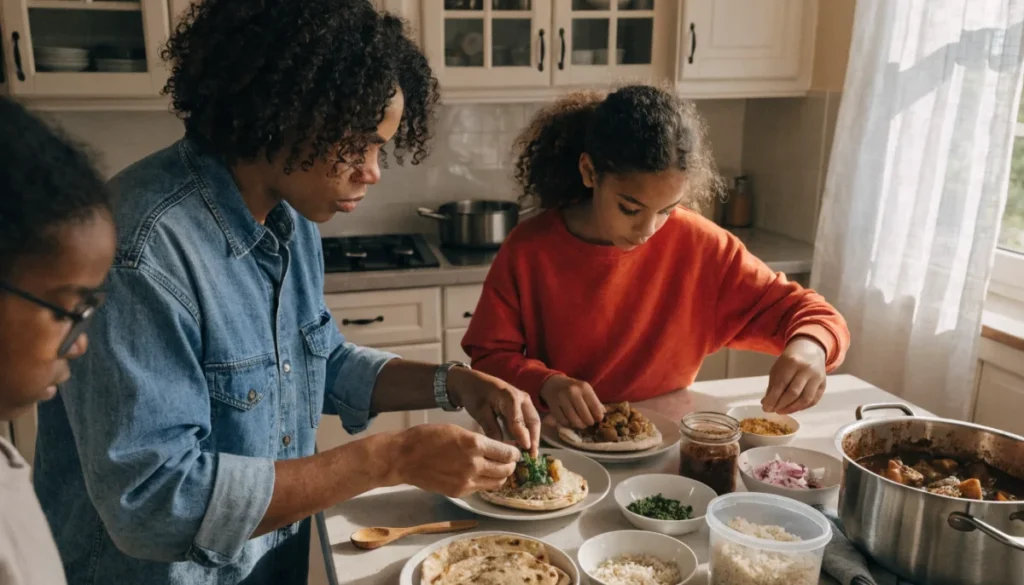
Serve it in parts. Almost every cuisine has a dish that can be deconstructed — a stew with rice and toppings, a curry with flatbread and yogurt, a tagine with couscous alongside. Components in separate bowls, assembled at the table. Nothing about the recipe changes; only the presentation does.
Give them a job in the cooking. Tearing herbs, stirring, pressing dough, sprinkling. A child who helped make the dish arrives at the table already invested in it. This is the single highest-return habit on this list.
Adjust heat at the table, not in the pot. Cook the dish properly and let chilli, pepper or hot sauce be added by whoever wants it. You are not making a milder version of your food; you are serving it the way adults in many households already do.
Name it. Children eat “dragon rice” more readily than “rice”. It sounds silly and it works, and it costs nothing.
Make it handheld. Wrapped, rolled, skewered or scooped, food gets eaten. Nearly every cuisine has a form of this already.
Let colour do the work. A plate with three colours on it is more appealing than a plate with one. That is not a Western trick — it is how most home cooking already looks when it has not been simplified for children.
What not to do
Do not hide vegetables. Blending cauliflower into the sauce works exactly once, and what a child learns from it is that food from your kitchen cannot be trusted. Serve the vegetable visibly and let it become familiar.
Do not apologise for your food. Children read hesitation instantly. “You probably won’t like this” is a prediction that comes true.
Do not make the separate meal. The moment it exists, it becomes the default.
The long view
The goal is not a child who eats everything tonight. It is an adult who eats the food they grew up with, cooks it for their own children, and does not think of vegetables as a punishment. That outcome is built from ordinary repeated dinners, in your own kitchen, cooking your own food.
If you want somewhere to start, our recipe library is built on the same principle: simple, assembled at the table, and designed to sit alongside whatever you already cook rather than replace it.