
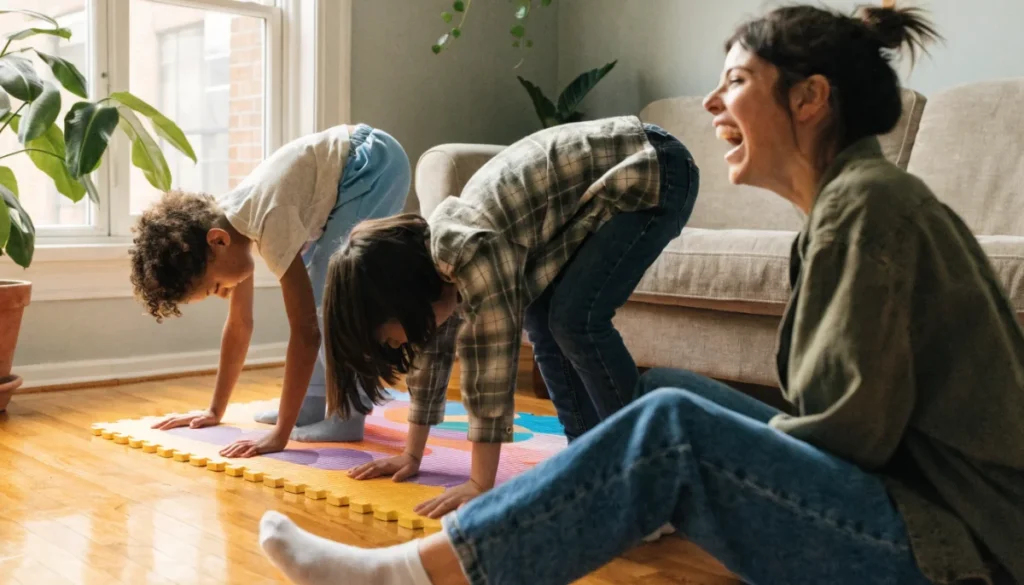
Canada’s own guidance asks for 60 minutes of moving a day for school-age children. Said out loud, that sounds like a second job. In practice it is a walk, a game in the yard, and about fifteen minutes of something structured — and the structured part is the bit most parents get stuck on.
Why “just go outside and play” stopped being enough
It still works, and it is still the best thing on the list. But the average Canadian winter is five months long, the average back garden is not a gym, and a child who has spent the day sitting at a desk does not always know what to do with a free hour. Structure helps — not because play is insufficient, but because a plan removes the negotiation.
That is all a kids workout is: a plan short enough to finish. Not training. Not a programme with a goal at the end of it. Fifteen minutes with a beginning, a middle and a laugh.
What a good session actually looks like
The fifty sessions in the Kidzy workout library all follow the same shape, because the shape is what makes them repeatable:
- A warm-up that is a game. Animal relays, reaction games, follow-the-leader. Five to eight minutes. The purpose is to get moving and get interested, in that order.
- Two skills. One movement taught properly — an air squat, a push press with a light ball, a plank — practised in small sets. Demonstration first, then short practice, then on.
- A short workout. Six to twelve minutes of putting those skills together under mild fatigue. Small rep schemes. Quality before speed, always.
- A game to finish. Tag with a twist, a relay, a team collection game. Nobody is eliminated and nobody sits out.
The rules that make it safe
Children are not small adults, and a kids session is not an adult session with lighter weights. Three things matter more than the exercises themselves:
No maximal effort. No one-rep maxes, no lifting to failure, no timed all-out sprints for score. Growing joints do not need it and nothing is gained.
Scaling is offered, not earned. An easier version is always available and choosing it is never framed as failing. A push-up on a box is a push-up.
Coaching is short. One cue at a time. “Chest tall.” “Heels down.” A child who is being corrected for thirty seconds has stopped listening at ten.
What you need
Across all fifty sessions, the equipment list is cones, beanbags, a light ball, a low box or bottom stair, and floor space. Water bottles work as light weights. A folded towel works as a mat. If you have a garden, a corridor and a kitchen counter, you have a gym.
How to start without it becoming a battle
Pick a session. Run it once this week, not four times. Let your child choose the finishing game. If it goes badly, run the same one again next week rather than trying a harder one — familiarity is what turns a session into a habit, and a habit is the only thing here that compounds.
Children who move regularly sleep better, concentrate better at school and feel more capable in their own bodies. None of that requires a programme, a subscription or a gym membership. It requires fifteen minutes and something worth turning up for.
Browse all fifty workouts — they are free, and each one lists its warm-up, skills, workout and game in full.