By Reza Mashkoori | Co-Founder, Kidzy Canada
What if some of the foods we regularly feed our kids are doing more than just affecting their physical health? What if they could also be connected to how our children feel, focus, and behave?
A new Canadian study is raising some pretty interesting questions about the relationship between ultra-processed foods and childhood behaviour.
And as a parent of two young kids, this one definitely caught my attention.
We’ve all been there. You’re rushing to get the kids ready for school, packing lunches, juggling activities, and trying to make sure everyone gets something nutritious to eat. Sometimes convenience wins. A packaged granola bar here, a juice box there, maybe some crackers or a quick frozen meal.
But what happens when these foods become a significant part of our children’s diets?
Let’s look at what the science actually says.
A Canadian Study That Every Parent Should Know About
In March 2026, researchers from the University of Toronto published a study in JAMA Network Open examining the relationship between ultra-processed food consumption and behavioural development in children.
The researchers followed 2,077 Canadian children, studying their diets at age three and assessing their emotional and behavioural development at age five.
What they found was concerning.
Children who consumed higher amounts of ultra-processed foods at age three tended to have higher scores for behavioural and emotional difficulties at age five, including:
- Anxiety and fearfulness
- Aggression
- Hyperactivity
- Other emotional and behavioural challenges
Here’s another interesting finding: ultra-processed foods accounted for an average of 45.5% of daily calories among the three-year-olds in the study.
Let that sink in.
Nearly half of the calories consumed by these young children came from ultra-processed foods.
Now, before we start throwing away everything in our pantries, there’s an important distinction to make.
The study found an association, not proof that ultra-processed foods cause behavioural problems.
Researchers also used statistical models to examine what might happen when some ultra-processed foods are replaced with minimally processed alternatives. Those models were associated with better behavioural scores, but they weren’t actual dietary interventions.
So, no, eating a cookie isn’t going to suddenly make your child hyperactive. And this research doesn’t suggest that changing your child’s diet will cure ADHD, anxiety, or other behavioural concerns.
What it does suggest is that the overall quality of our children’s diets deserves more attention.
And that’s a conversation worth having.
What Exactly Are Ultra-Processed Foods?
This is where things can get confusing.
Not all processed food is bad. In fact, processing food can make it safer, more affordable, and more convenient.
Frozen vegetables? Processed.
Plain yogurt? Processed.
Canned beans? Processed.
All can be part of an incredibly nutritious diet.
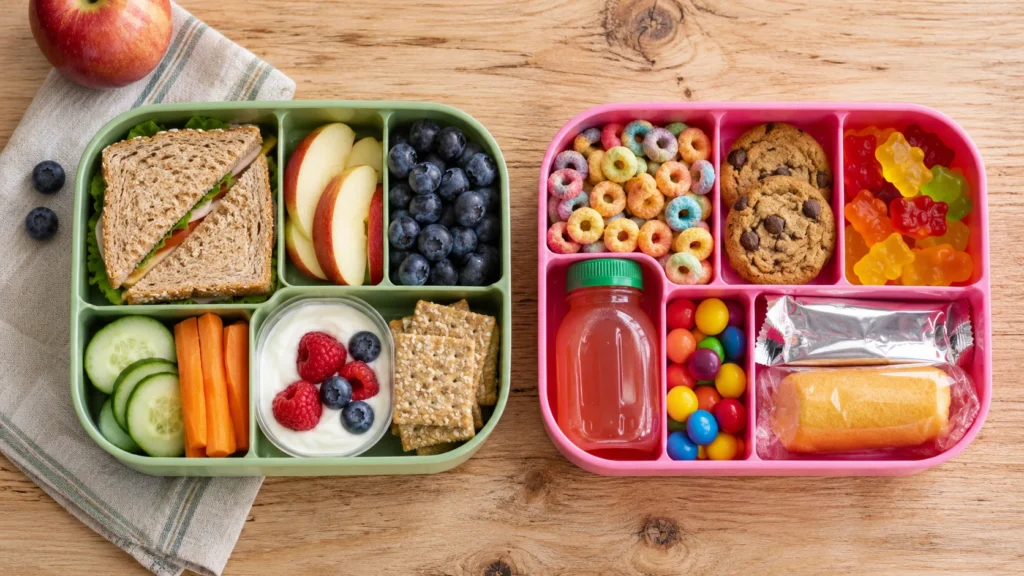
Ultra-processed foods are different. They’re generally industrially formulated products that contain ingredients or additives not commonly used in home cooking.
Some common examples include:
- Sugary breakfast cereals
- Soft drinks and many fruit-flavoured drinks
- Packaged cakes and snack foods
- Many candy products
- Some ready-to-heat meals
- Certain highly formulated snack bars
One important thing to remember is that not every product in these categories is identical. Ingredients and nutritional quality can vary significantly between brands.
My advice? Stop judging a food solely by its packaging and start looking at what’s actually inside it.
Flip the package over. Read the ingredient list. Check the Nutrition Facts table.
A product’s marketing might tell you it’s natural, wholesome, or made with real fruit. But that doesn’t necessarily mean it’s a nutritious choice.
Why Might Food Be Connected to Behaviour?
This is where the conversation gets particularly interesting.
Our children’s brains and bodies are developing rapidly. They’re learning, growing, moving, and navigating new emotions every single day.
And nutrition plays an important role in supporting that development.
A healthy eating pattern helps provide nutrients that children need for normal growth and brain function, including protein, healthy fats, iron, and other vitamins and minerals.
When ultra-processed foods make up a large portion of a child’s diet, they may displace other foods that offer more fibre and essential nutrients.
Researchers are also interested in how overall dietary patterns, the gut microbiome, and other biological processes may relate to emotional and behavioural health.
But we need to be careful here.
We don’t yet know exactly why the association seen in the Canadian study exists, or whether ultra-processed foods themselves are directly responsible.
Behaviour is complicated. Sleep, physical activity, stress, family environment, genetics, and developmental differences all matter.
Food is one piece of a much bigger puzzle.
And it’s a piece we can help our children understand.
Five Simple Food Swaps That Can Make a Difference
One thing I’ve learned from working with kids is that education works a lot better when it’s fun, simple, and practical.
We don’t need to completely overhaul our kitchens overnight.
Instead, let’s focus on small, realistic changes.
1. Rethink the breakfast cereal
Instead of reaching for a cereal loaded with added sugar, try oatmeal topped with berries, banana, and cinnamon.
You’ll provide fibre and important nutrients while still giving your child a breakfast that tastes great.
2. Swap the juice box for water and whole fruit
One of the easiest changes we can make is to rethink what our kids are drinking.
Water should be our everyday go-to.
If your child enjoys fruit flavours, offer sliced strawberries, oranges, or another favourite fruit alongside their water.
Whole fruit also provides fibre that juice doesn’t.
3. Make yogurt your own
Some flavoured yogurts contain significant amounts of added sugar.
Try plain yogurt with fresh berries, banana, or a little cinnamon.
You can even turn it into a fun activity and let your kids build their own yogurt bowls.
4. Upgrade the afternoon snack
Instead of automatically grabbing a packaged snack cake or sweetened bar, try pairing a fruit with a protein food.
Apple slices and cheese, hummus and carrots, or a hard-boiled egg with whole grain crackers can all be easy options.
Convenient doesn’t have to mean lacking nutrition.
5. Get the kids involved in making meals
Instead of relying on a ready-made meal every time you’re busy, try a quick homemade alternative when time allows.
Mini pizzas made with whole grain pitas, tomato sauce, cheese, and your child’s favourite vegetables are a great place to start.
Let your child choose their toppings, assemble the pizza, and take ownership of the process.
At Kidzy, we’re big believers that children who understand food are better equipped to make informed choices about it.
Does This Mean Kids Should Never Eat Ultra-Processed Foods?
Absolutely not.
I’m a parent. I understand that birthday parties happen. Halloween happens. Busy Tuesdays happen.
The goal shouldn’t be to make our kids afraid of food or create a list of foods they’re never allowed to enjoy.
Food is also about family, culture, celebrations, and enjoyment.
The important thing is what our children eat consistently over time.
If most of their meals and snacks contain a variety of vegetables, fruits, whole grains, and protein foods, there’s room for flexibility.
What concerns me more is when convenience foods become the default, rather than the occasional option.
And I think that’s where we have an opportunity to make meaningful changes.
The Bigger Problem: Are We Teaching Kids Enough About Food?
This is one of the reasons we started Kidzy Canada.
We spend a lot of time teaching children how to read, write, solve math problems, and develop social skills.
But how much time do we spend teaching them how to understand the food they put into their bodies?
Do they know what protein does?
Do they understand why fibre matters?
Can they identify the difference between a whole food and a highly processed snack?
Do they know how to look at a food label?
These are skills that can benefit them for the rest of their lives.
And I believe we should start teaching them early.
Not through fear.
Not by labelling foods as good or bad.
But through curiosity, education, and positive experiences.
When kids understand why something matters, they’re more likely to take an interest in it.
That’s the approach we’re building at Kidzy.
My Challenge to Parents This Week
Here’s something simple I’d encourage you to try.
Take five minutes with your child and explore the kitchen together.
Pick three packaged foods that your family regularly eats.
Turn them around and read the ingredient lists.
Ask your child:
“Do you recognize any of these ingredients?”
“What do you think this food does for your body?”
“Could we make something similar at home?”
You might be surprised by how curious kids become when we invite them into the conversation.
And remember, this isn’t about throwing out food or making anyone feel guilty.
It’s about building awareness.
Because the more our children understand nutrition today, the better prepared they’ll be to make informed decisions tomorrow.
Final Thoughts
The University of Toronto study doesn’t give us all the answers.
But it adds to a growing conversation about the relationship between childhood nutrition, development, and long-term health.
For me, the takeaway is simple.
We don’t need perfect diets. We need better habits, more education, and healthier food environments for our kids.
That’s what we’re working toward at Kidzy Canada.
Helping families build healthier habits today, while advocating for a healthier world for every child tomorrow.
If you’re interested in practical nutrition advice, family-friendly recipes, and fun ways to get your kids moving, explore Kidzy Canada and follow us on Instagram @kidzycanada.
Let’s make healthy living something kids understand, enjoy, and get excited about.
— Reza
Sources and Further Reading
- Kavanagh et al. (2026), Ultraprocessed Food Consumption and Behavioral Outcomes in Canadian Children, JAMA Network Open
- University of Toronto: Preschoolers Who Eat Ultra-Processed Foods More Likely to Experience Behavioural Challenges
- Health Canada: Healthy Eating for Parents and Children
- Canada’s Food Guide: Limit Highly Processed Foods